
What Is Weathering?
Weathering testing is a test group that assesses a material's ageing under the combined effects of sun, heat, humidity and pollutants. It is conducted naturally (outdoor) or in accelerated form (laboratory).
Purpose of Weathering
The purpose is to determine how long a material intended for outdoor use retains its appearance and mechanical properties.
Which Products Is Weathering Applied To?
- Building profiles and facade elements
- Automotive exterior parts
- Paint and coating systems
- Garden furniture and outdoor plastics
- Membranes and roofing
In Which Sectors Is Weathering Used?
Standards Related to Weathering
- ISO 877
- ASTM G7
- ASTM G24
- ISO 4892-2
- ISO 4892-3
- ASTM G155Accelerated aging with xenon arc test
- ASTM G154fluorescent UV accelerated aging test
Weathering Conditions
- Method
- Natural outdoor exposure or laboratory accelerated aging
- natural exposure
- Panel angle, orientation and climate zone are defined in the standard
- Accelerated
- Xenon arc or fluorescent UV cycles
- Time
- Years of natural exposure; Hundreds to thousands of hours in time-lapse
Equipment for Weathering
- Outdoor exposure racks (natural method)
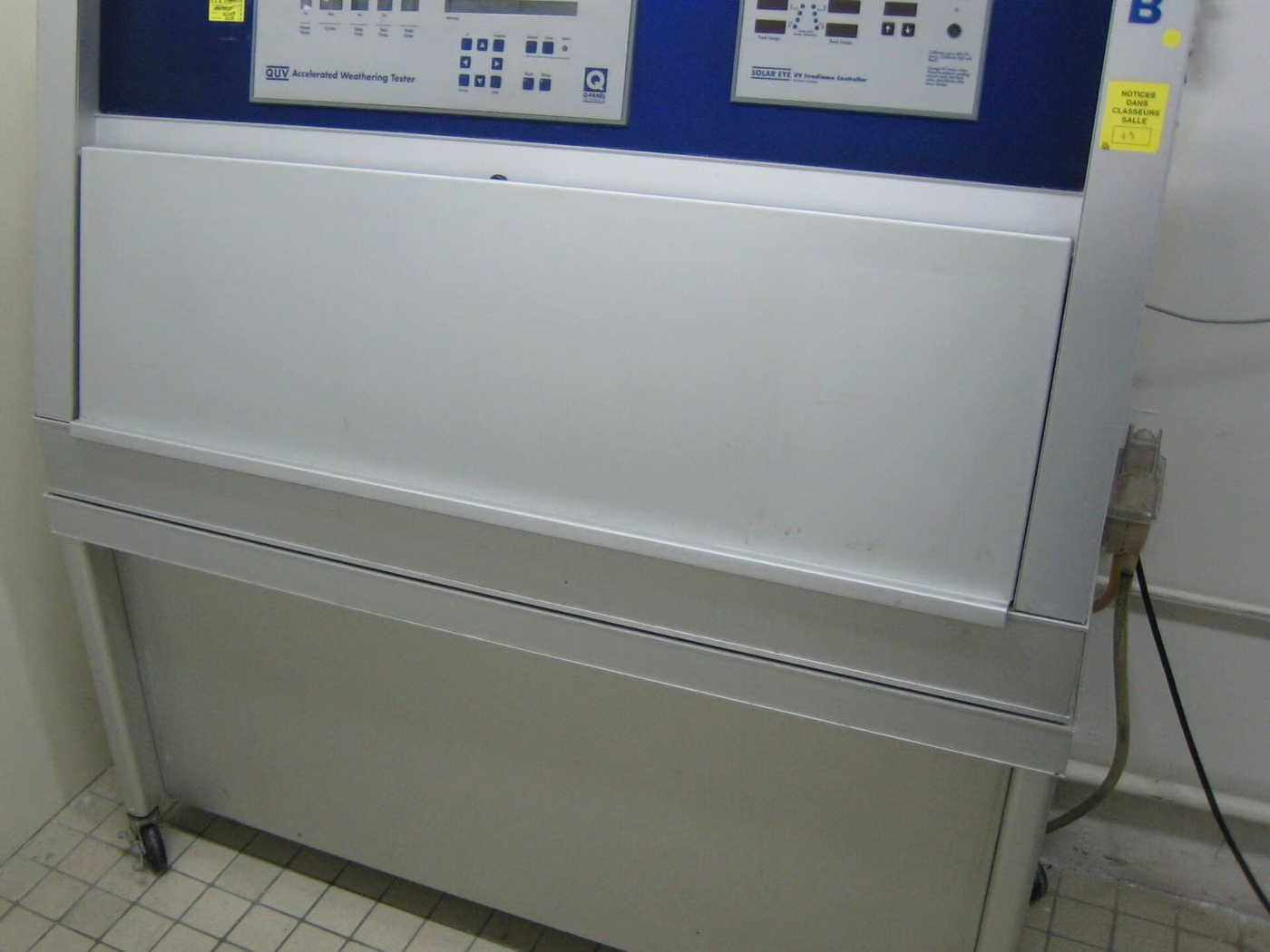
- Xenon arc or fluorescent UV chamber
- Colour, gloss and mechanical measurement instruments
- Meteorological data logging (natural method)
Sample Requirements for Weathering
- Initial colour, gloss and mechanical values must be measured
- A reference sample must be kept in the dark
- Panel angle and orientation must be recorded for natural exposure
- Generally at least three specimens
Duration of Weathering
One to five years for natural exposure; weeks to months for accelerated methods, depending on the specification.
Weathering Procedure
- 1Initial measurements are taken and a reference sample is kept.
- 2A method is selected: natural exposure or accelerated cycling.
- 3Samples are placed at the defined angle and location.
- 4Interim measurements are taken at defined intervals.
- 5At the end of the exposure, colour difference, gloss and mechanical properties are compared.
Weathering Acceptance Criteria
The acceptance criterion is given in the specification as maximum colour difference, maximum gloss loss, or minimum retained mechanical property.
Evaluation of Results
Accelerated results do not translate directly to natural exposure; correlation can only be established with coefficients validated for the same material class. The method must therefore always be stated in the report.
Weathering Report
- Standard and method applied
- Exposure conditions or cycle programme
- Total duration or irradiance
- Colour, gloss and mechanical results
- Reference sample comparison
Accreditation
EUROLAB holds internationally recognised accreditation obtained from accreditation bodies party to the IAF and ILAC multilateral recognition arrangements, under ISO/IEC 17025 for laboratory testing, ISO/IEC 17020 for inspection and surveillance, and ISO/IEC 17021-1 and ISO/IEC 17065 for system and product certification. This chain ensures the reports and certificates issued are accepted worldwide.
Whether this test can be offered within accredited scope depends on your product and the standard applied; since accreditation is method-based, the scope is confirmed in writing at the quotation stage.
Scope and authorisationsRelated Regulations
- Construction and automotive material specifications
Environmental and Climatic Testing — What Does This Testing Field Cover?
The section below describes the field that the Weathering test belongs to; the conditions and acceptance criteria of this particular test are given in the sections above. The scope specific to your product is confirmed in writing at the quotation stage.
Environmental testing shows whether a product withstands ambient factors such as temperature, humidity, pressure, solar radiation, dust, water and corrosive atmospheres. The aim is not to break the product but to bring forward, in ACCELERATED form, the conditions it will meet over its life.
Test profiles are derived from the product's real exposure, and that derivation is the actual engineering work of the field. A device operating in an enclosed office and one mounted on a pole are not tested with the same profile. The IEC 60068 series defines general methods, MIL-STD-810 military profiles, RTCA DO-160 aviation profiles and the ISO 16750 series location-based automotive profiles. A test applied without a profile selection produces both unnecessary cost and false confidence.
Temperature tests simulate three separate phenomena and all three produce different failure modes. Steady high/low temperature tests whether the material can operate at that temperature. Temperature CYCLING creates fatigue at joints between materials with different expansion coefficients — solder cracks appear here. Thermal SHOCK intensifies this effect through an abrupt transition.
There is a distinction in humidity testing too. Steady damp heat shows the diffusion of moisture into the material and its effect on insulation properties. Cyclic damp heat creates condensation: water droplets form on the cooling surface, and this is far more aggressive than dry humidity. Water ingress into enclosures, increased leakage current and corrosion usually appear in the cyclic test.
Dust and water protection is a separate body of work and is expressed by the IP code. The point to note here is that an IP test is not a DURABILITY test: it shows that protection is provided under defined and short-duration conditions, not resistance to long-term immersion or pressure washing.
The most common mistake in this family is translating a test result directly into a LIFE PREDICTION. Accelerated tests are designed for comparison and design verification; a reliable conversion between hours in a chamber and years in the field can only be established with a material-specific acceleration model calibrated against field data.
Functional monitoring determines the value of the test. Keeping a product in a temperature chamber and then switching it on does not show what happened DURING the test. In critical applications the product is operated throughout the test and its parameters are monitored; intermittent faults that appear and disappear can only be caught this way.
Method groups in this field
Temperature
Dry heat, cold, change of temperature and thermal shock; steady and cyclic profiles.
Humidity
Steady damp heat and cyclic damp heat; cycles with condensation are more aggressive.
Water and dust
IP protection tests: dripping, spraying, jets, immersion and dust tightness.
Radiation and ageing
Accelerated ageing by xenon arc and fluorescent UV, solar radiation simulation.
Pressure and altitude
Low pressure (altitude) and rapid pressure change tests.
Corrosive atmosphere
Salt spray, mixed flowing gas corrosion (simulating industrial atmospheres), mould and fungus tests.
Commonly confused in this field
- Test duration cannot be converted into field life; a conversion made without an acceleration model is misleading.
- Temperature cycling and steady temperature produce different failure modes; neither replaces the other.
- If the product is not operated during the test, intermittent faults remain invisible; functional monitoring determines the value of the test.
- IP protection is not evidence of durability; it shows protection under defined and short-duration conditions.
- A test applied without profile selection both increases cost and gives false confidence.
- The mounting and orientation arrangement affects the result; the report must document it.
Which decisions these results support
- Design verification and qualification
- Declaration of the protection class and operating temperature range
- Reproducing field failures in the laboratory and root cause analysis
- Supplier component approval
- Decisions on warranty period and storage conditions
Related Tests
Frequently Asked Questions About Weathering
How many years of natural exposure does an accelerated test correspond to?
There is no universal conversion factor. Correlation depends on the material class, degradation mechanism and climate zone. Specifications therefore usually define test duration or total irradiance directly.