
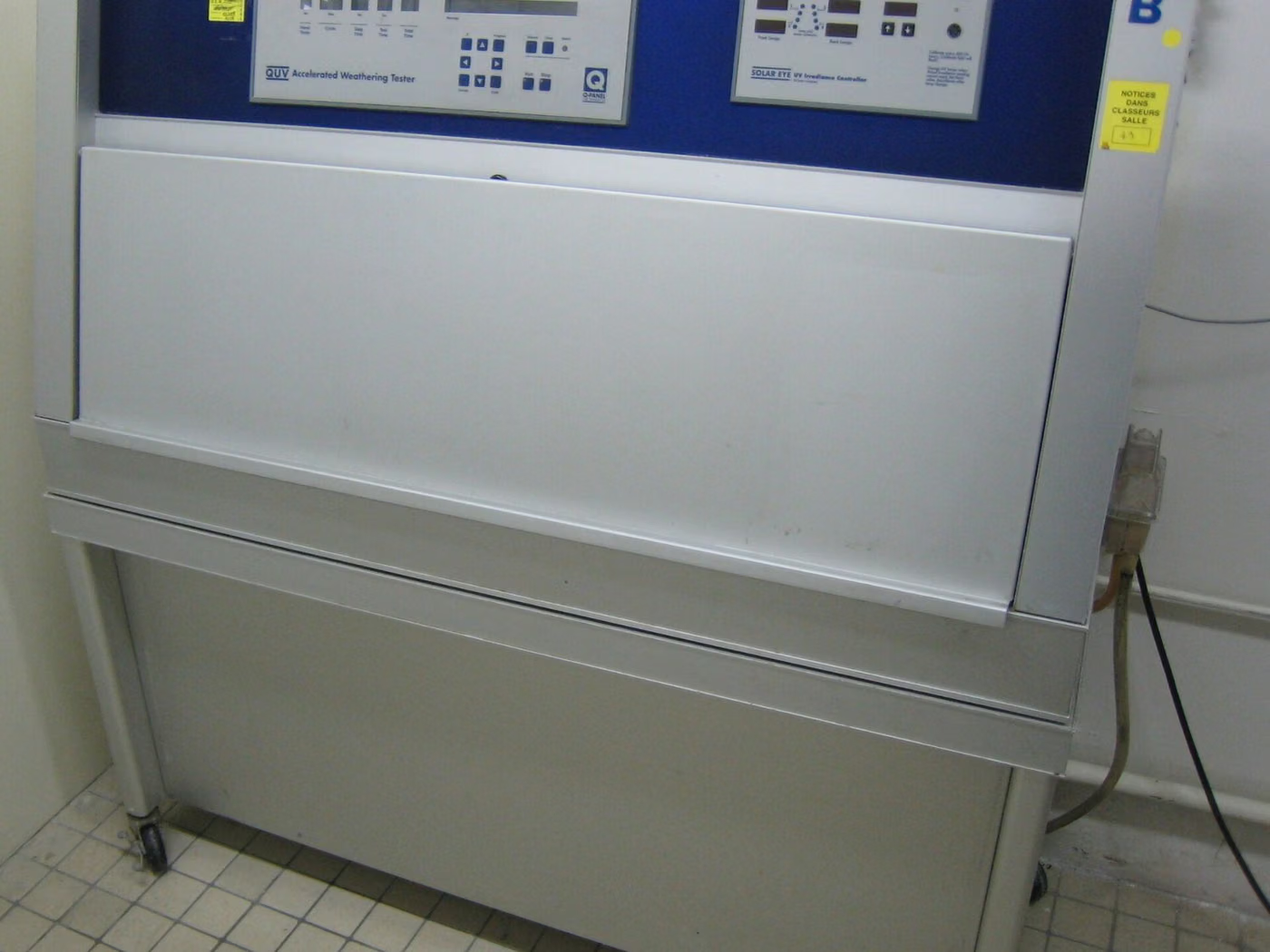
What Is UV Weathering?
UV ageing mimics, in a short laboratory time, the years-long degradation a material undergoes outdoors. The sample is exposed to controlled light, temperature and humidity cycles. There are two common light sources: fluorescent UV lamps (ISO 4892-3 / ASTM G154) and xenon arc, which better mimics the solar spectrum (ISO 4892-2 / ASTM G155).
Purpose of UV Weathering
The purpose is to comparatively assess colour fading, gloss loss, cracking and decline in mechanical strength in products intended for outdoor use. The test does not give an absolute life; it compares different formulations under the same conditions.
Which Products Is UV Weathering Applied To?
- Exterior facade plastic and composite products
- Automotive exterior and interior parts
- Paint and coating systems
- Textile and awning fabrics
- Garden furniture and play equipment
In Which Sectors Is UV Weathering Used?
Standards Related to UV Weathering
- ISO 4892-2 (exposure to xenon arc lamps)
- ISO 4892-3 (exposure to fluorescent UV lamps)
- ASTM G154 (accelerated exposure with fluorescent UV)
- ASTM G155 (accelerated exposure with xenon arc)
- ISO 105-B02 (colour fastness to light in textiles — related method)
UV Weathering Conditions
- Light source
- Fluorescent UV or xenon arc; from specification
- Cycle
- Program consisting of light and condensation/spray steps
- Temperature
- Black panel temperature is kept at a standard-defined level
- Time
- Total exposure time or radiant energy; from specification
Equipment for UV Weathering
- Fluorescent UV ageing chamber (QUV type)
- Xenon arc test chamber
- Irradiance measurement and control system
- Colour meter (spectrophotometer) and gloss meter
- Reference materials
Sample Requirements for UV Weathering
- The sample must be taken so as to represent the batch or production run.
- Sample description, material type, and production direction if any, must be stated.
- The standard to be applied and any customer specification must be provided together with the sample.
- The test may be destructive; the required number of samples must be confirmed in advance.
- Surfaces that will be tested must be protected during transport.
Duration of UV Weathering
Exposure duration depends on the specification and can reach hundreds to thousands of hours; the study takes weeks. Interim assessment points divide the total duration to allow monitoring.
UV Weathering Procedure
- 1The light source, cycle programme and total duration are determined from the specification.
- 2Samples are cut and initial measurements (colour, gloss, mechanical) are taken.
- 3Samples are placed on the chamber panels.
- 4The programme is started and irradiance is continuously checked.
- 5Samples are removed and assessed at defined interim points.
- 6Samples' positions within the panel are rotated.
- 7Final measurements are taken at the end and the change is calculated.
UV Weathering Acceptance Criteria
The method standard defines how the test is performed, not what the result must be. The acceptance limit comes from the material or product standard, the customer specification, or the relevant regulation; this page therefore does not give a numerical limit.
Evaluation of Results
The result is given as colour difference, gloss loss and mechanical property change relative to the start. The acceptance limit comes from the product specification. The laboratory result is not directly a field life; converting it to a field value requires a correlation validated for that material.
UV Weathering Report
- Sample description, material/product information, and batch number if any
- Sample preparation method and conditioning conditions
- Standard and test conditions applied
- Instrument used and calibration status
- Measurement results and units
- Measurement uncertainty (if requested)
- A statement that the result applies only to the specimen submitted for testing
Accreditation
EUROLAB holds internationally recognised accreditation obtained from accreditation bodies party to the IAF and ILAC multilateral recognition arrangements, under ISO/IEC 17025 for laboratory testing, ISO/IEC 17020 for inspection and surveillance, and ISO/IEC 17021-1 and ISO/IEC 17065 for system and product certification. This chain ensures the reports and certificates issued are accepted worldwide.
Whether this test can be offered within accredited scope depends on your product and the standard applied; since accreditation is method-based, the scope is confirmed in writing at the quotation stage.
Scope and authorisationsRelated Regulations
- Harmonised standards applied according to the product family
- EU 765/2008 (market surveillance and accreditation framework)
- Relevant product regulations and customer specifications
Plastics Testing — What Does This Testing Field Cover?
The section below describes the field that the UV Weathering test belongs to; the conditions and acceptance criteria of this particular test are given in the sections above. The scope specific to your product is confirmed in writing at the quotation stage.
Plastics testing determines the mechanical, thermal and burning behaviour of a polymer material. Unlike metals, plastics are VISCOELASTIC: their behaviour depends on loading rate, temperature and moisture. The same material therefore gives different results under different conditions, and the test conditions are an inseparable part of the result.
The practical consequence of viscoelasticity is this: a plastic part continues to deform over time under a constant load (creep) and the stress it carries at constant deformation falls over time (stress relaxation). A screwed joint loosens, a clamp loses its clamping force, a shelf sags over time. A short-term tensile test does not show this behaviour; a long-term test or an accelerated model is needed.
Thermal behaviour is the second main axis. Melt flow rate indicates the processability of the material and lot-to-lot consistency; heat deflection temperature and the Vicat softening point give a rough limit for service temperature. Thermal analysis (DSC, TGA, DMA) reveals the identity of the material: glass transition temperature, melting behaviour, crystallinity, filler content and decomposition temperature.
Burning behaviour is the third axis and ties directly into product standards. The UL 94 class and the limiting oxygen index are written into the material data sheet; a particular class is required for the housing of an electrical appliance, while a different classification system applies to a construction product.
Ageing is the most frequently skipped part of the field. Plastics degrade under UV, heat, moisture and oxygen: colour changes, the surface cracks, impact strength falls. For a part intended for outdoor use, what matters is not its values on day one but its values after ageing. Xenon arc and fluorescent UV equipment accelerate this degradation and allow comparison.
The output of this family is usually written into the material data sheet, and product standards refer to that sheet. But there can be a difference between the data sheet value and the behaviour of the actual part: orientation formed during moulding, weld lines and internal stresses make the part behave differently from the specimen.
The use of recycled content has added a new question to the field. Recycled resin varies from lot to lot; mechanical properties, colour and burning behaviour can shift between batches. For a manufacturer using recycled material, incoming material control is therefore not a choice but a necessity.
Method groups in this field
Mechanical
Tension, compression, bending, Charpy and Izod impact, hardness (Shore), creep and environmental stress cracking.
Thermal
Melt flow index (MFI), heat deflection temperature (HDT), Vicat softening temperature, linear thermal expansion.
Thermal analysis
Transition temperatures and crystallinity by DSC, composition and decomposition by TGA, dynamic mechanical behaviour by DMA.
Burning
UL 94 classification, limiting oxygen index (LOI), glow wire and needle flame tests.
Ageing
Accelerated ageing by xenon arc and fluorescent UV, hot air ageing, humidity and condensation.
Physical
Density, water absorption, ash content, gas and water vapour permeability of films and sheets.
Commonly confused in this field
- A plastics result without a stated test rate and temperature cannot be interpreted; viscoelastic behaviour depends on these parameters.
- A specimen result does not transfer directly to the actual part; moulding orientation and weld lines are decisive.
- HDT and Vicat values are NOT service temperatures; they are a rough indication of an upper limit and do not apply under load.
- The UL 94 class depends on thickness; a different wall thickness requires re-verification.
- For moisture-absorbing polymers (such as polyamide), results are misleading unless conditioning is carried out.
- ASTM D638 and ISO 527 results are not directly equivalent; the specimen geometries and rate definitions differ.
Which decisions these results support
- Material selection and supplier approval
- Meeting the flammability and thermal requirements of the product standard
- Verifying the use of recycled content and lot control
- Moulding process control and lot consistency
- Demonstrating ageing resistance for outdoor use
Related Tests
Frequently Asked Questions About UV Weathering
How many years outdoors does 1000 hours correspond to?
There is no universal conversion. The acceleration factor depends on the material, climate zone, and test cycle; an unvalidated conversion is misleading.
Fluorescent UV or xenon arc?
Fluorescent UV tests degradation dominated by short-wavelength UV quickly and economically. Xenon arc better mimics the solar spectrum and is preferred in colour-fading studies.