
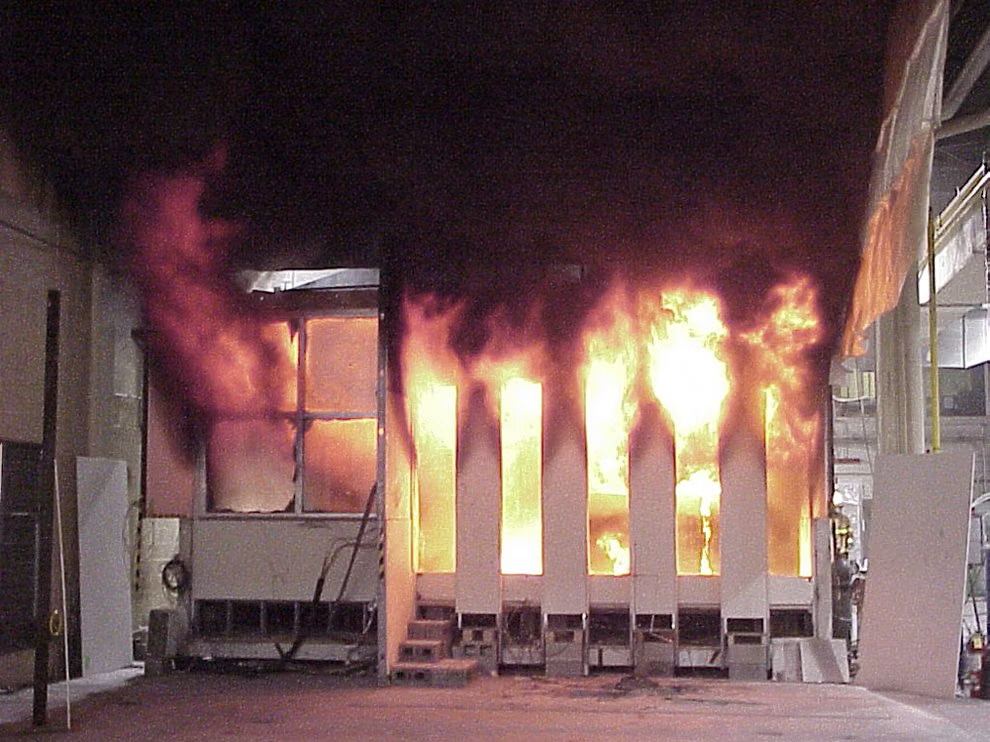
What Is Surface Burning — ASTM E84?
ASTM E84 is a tunnel test that measures how quickly flame spreads across the surface of a building material and how much smoke it produces. The specimen is placed on the tunnel's ceiling; flame progression and smoke density are monitored under a controlled flame and airflow. Results are given as a flame-spread index and a smoke-developed index.
Purpose of Surface Burning — ASTM E84
The purpose is to classify how much interior surface finishes will contribute to fire growth. North American building codes classify interior surface materials according to these indices.
Which Products Is Surface Burning — ASTM E84 Applied To?
- Wall and ceiling lining panels
- Insulation materials
- Acoustic panels
- Wood-based boards
- Paint and surface-coating systems
In Which Sectors Is Surface Burning — ASTM E84 Used?
Standards Related to Surface Burning — ASTM E84
- ASTM E84flame spread on the surface test
Surface Burning — ASTM E84 Conditions
- Test apparatus
- Steiner tunnel; dimensions and airflow are fixed in the standard
- Time
- Monitoring for the test duration defined in ASTM E84
- Reference
- Indices are scaled relative to selected reference materials
- Specimen orientation
- The specimen is placed on the tunnel ceiling
Equipment for Surface Burning — ASTM E84
- Steiner tunnel test rig
- Controlled gas burner and airflow system
- Photometric smoke measurement system
- Flame-progression observation windows
- Data acquisition system
Sample Requirements for Surface Burning — ASTM E84
- The specimen must be large enough to cover the tunnel dimensions — this is a large specimen
- The material must be presented in the same mounting configuration as in real application
- If an adhesive and a substrate are used, the whole system must be tested
- The test is destructive; the specimen is not returned
Duration of Surface Burning — ASTM E84
The test itself is short; together with specimen preparation, conditioning and tunnel setup, the result comes out within a few working days.
Surface Burning — ASTM E84 Procedure
- 1The specimen is conditioned and placed on the tunnel ceiling.
- 2The airflow and burner conditions are set.
- 3The flame is applied and the progression of the flame front is recorded.
- 4Smoke density in the exhaust is measured continuously.
- 5The test duration is completed.
- 6The flame-spread and smoke-developed indices are calculated.
- 7Results are compared with the code classes.
Surface Burning — ASTM E84 Acceptance Criteria
Index limits are set by the building code; ASTM E84 only defines the measurement and index calculation, not the class limit.
Evaluation of Results
The indices are a relative scale and are not a complete prediction of real fire behaviour. In thermoplastic materials, dripping of the specimen onto the tunnel floor can affect the result; this behaviour is recorded in the report.
Surface Burning — ASTM E84 Report
- Sample description, serial number and configuration
- Applied standard and year of printing
- Selected intensity level and basis for the level
- Experimental setup and measurement points
- Functional checks performed during the experiment
- Observations, measurement results and photographs
- A statement that the result applies only to the specimen submitted for testing
Accreditation
EUROLAB holds internationally recognised accreditation obtained from accreditation bodies party to the IAF and ILAC multilateral recognition arrangements, under ISO/IEC 17025 for laboratory testing, ISO/IEC 17020 for inspection and surveillance, and ISO/IEC 17021-1 and ISO/IEC 17065 for system and product certification. This chain ensures the reports and certificates issued are accepted worldwide.
Whether this test can be offered within accredited scope depends on your product and the standard applied; since accreditation is method-based, the scope is confirmed in writing at the quotation stage.
Scope and authorisationsRelated Regulations
- IBC (International Building Code) interior-finish classes
- NFPA 101 Life Safety Code
- Local building codes
Standard-Based Tests — What Does This Group of Pages Cover?
The section below describes the field that the Surface Burning test belongs to; the conditions and acceptance criteria of this particular test are given in the sections above. The scope specific to your product is confirmed in writing at the quotation stage.
Standard-based tests are test pages whose address comes from a standard number. What the user is looking for is often not the name of the test but the code written in their specification: not "salt spray test" but "ASTM B117", not "drop test" but "IEC 60068-2-31", not "vibration" but "MIL-STD-810 Method 514".
This preference reflects the reality in the field. An engineer sees a code in the specification received from a customer and searches for that code; they do not need to know the name of the test. The code is the identity of the test and distinguishes the different adoptions of the same test by different bodies.
This group addresses the different adoptions of the SAME TEST separately. The same physical phenomenon may be published under different numbers by ISO, ASTM, EN, IEC, DIN and JIS. Even where the numbers are the same (as with ISO 6892-1 and EN ISO 6892-1), specimen preparation, conditions, calculation details and reporting may differ; adoptions may carry national annexes. The code written in the specification therefore governs, and "similar" is not accepted.
Searching at code level meets a different need from searching at scope level. A user searching for "corrosion testing" wants to learn about the field; a user searching for "ASTM B117" has a specification in hand and wants to know the feasibility, duration and price of that test. Two different intents require two different page structures.
The page for a code describes the scope of that code, the test field it belongs to, the product groups in which it is required and how it differs from neighbouring codes. Test conditions, durations and acceptance criteria are NOT CARRIED: these are defined in the copyrighted text of the standard and in the product specification. This boundary is a deliberate choice; a wrong duration or acceptance criterion means directly incorrect work.
Different parts of the same code and different adoptions of the same number are linked between pages. A user searching for IEC 60335 also sees 60335-2-40; a user searching for ISO 6892-1 also sees the EN ISO 6892-1 and DIN EN ISO 6892-1 adoptions. These links are derived from the number of the code rather than written by hand.
The edition year is NOT CARRIED in the library. It is held as "ASTM D638" rather than "ASTM D638-22", because the edition in force changes over time and the address of the page should not age with the edition. If a year is stated in your specification, that edition governs; if not, the most current edition is applied.
Method groups in this field
Searching by code
Direct search for the code written in the specification; it is found in the library with its code, scope title and issuing body.
Searching by scope title
A test whose code is not known is searched by its subject; a search for "salt spray" brings up the related codes.
Series and part relationships
The other parts of the same series are shown, derived from the number of the code.
Adoption relationships
Different bodies' adoptions of the same number are matched; the claim is kept limited to "the same number".
Superseded codes
Withdrawn codes are not held in the library but, when searched for, the user is directed to the counterpart in force.
Commonly confused in this field
- Different adoptions of the same number are not identical texts; they may carry national annexes.
- The code written in the specification governs; a technically similar code cannot be substituted.
- If an edition year is stated, that edition is applied; the most current edition is not automatically accepted.
- A code page carries no test conditions or acceptance criteria; these are in the copyrighted text of the standard and in the product specification.
- A part code (for example -2-40) may not be sufficient on its own; the general part of the series is applied as well.
Which decisions these results support
- Matching the code written in the specification to the correct laboratory scope
- Distinguishing between equivalent adoptions
- Clarifying the scope and edition at the quotation stage
- Finding the current counterpart of withdrawn codes
Related Tests



Frequently Asked Questions About Surface Burning — ASTM E84
Are ASTM E84 and EN 13501-1 interchangeable?
No. The two systems are based on different tests and different classification logic. E84 is required for the North American market and EN 13501-1 classification for the European market.
What does Class A mean?
It is the name building codes give to certain index ranges. The class definition comes from the code; the test report gives the index values.