
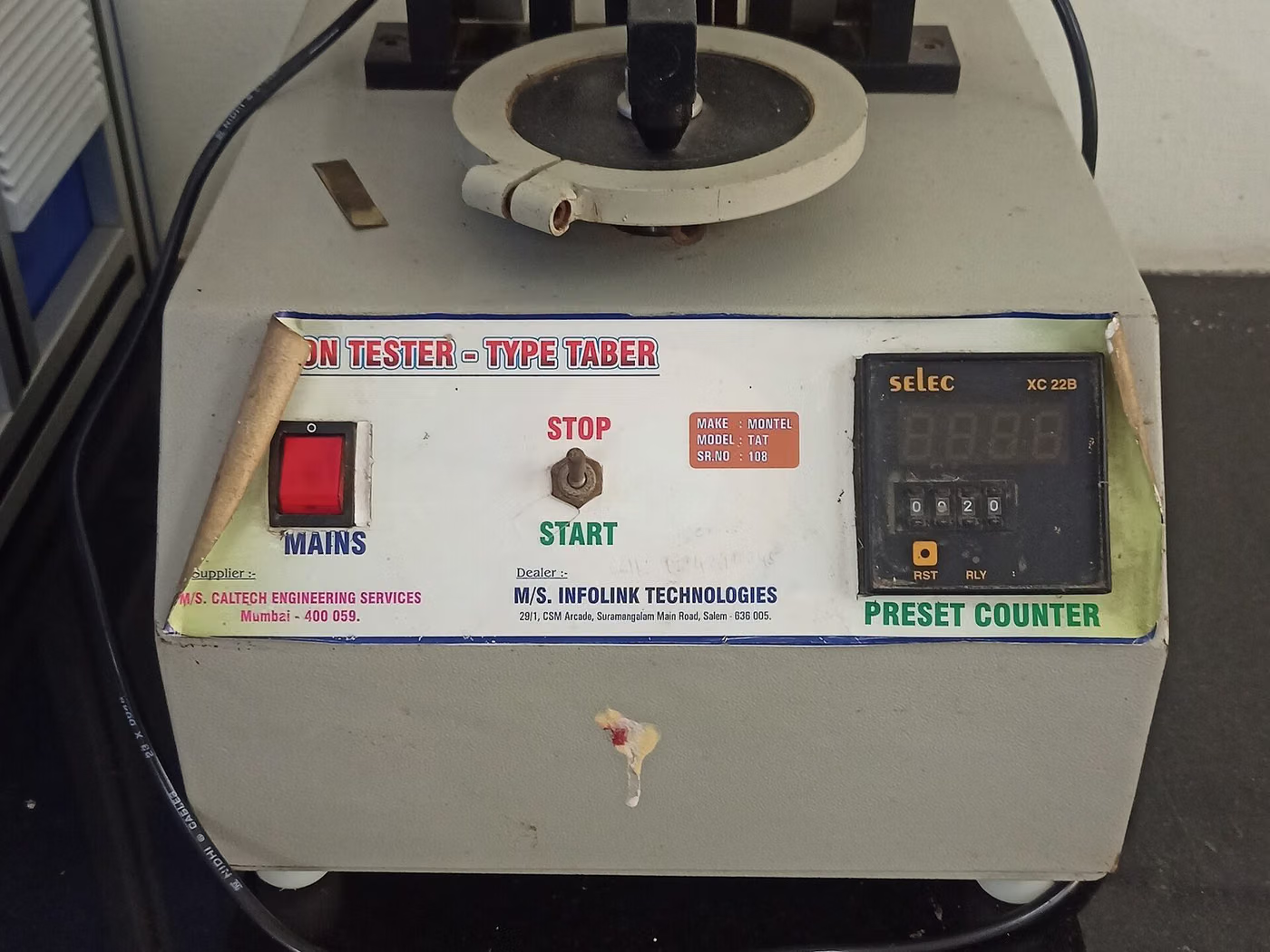
What Is Martindale?
In the Martindale test, the specimen is rubbed against a standard abrasive surface (wool fabric or abrasive paper) in a continuously changing direction known as a Lissajous pattern. The same instrument is also used for pilling assessment when the fabric itself is used in place of the abrasive.
Purpose of Martindale
The purpose is to measure how well the fabric will withstand friction over its service life and to assess whether fuzzing/pilling occurs on the surface. It is one of the most commonly required performance parameters in upholstery fabric specifications.
Which Products Is Martindale Applied To?
- Upholstery and furniture fabrics
- Automotive interior textiles
- Apparel fabrics
- Contract and hotel textiles
- Leather and synthetic leather surfaces
In Which Sectors Is Martindale Used?
Standards Related to Martindale
- EN ISO 12947-1 / -2 (determination of abrasion resistance by the Martindale method — specimen breakdown)
- EN ISO 12947-3 (determination of mass loss)
- EN ISO 12945-2 (pilling — Martindale method)
- EN ISO 5470-2 (abrasion resistance of coated fabrics)
Martindale Conditions
- Motion
- Rubbing that continuously changes direction in a Lissajous pattern
- Abradant
- Standard wool fabric or abrasive paper, per the application
- Pressure load
- Weight defined in the standard; different for apparel and upholstery
- Assessment intervals
- Interim inspection at the cycle steps defined in the standard
Equipment for Martindale
- Martindale abrasion and pilling tester
- Standard abradant fabric and felt set
- Specimen cutting dies
- Assessment cabinet with standard illumination
- Pilling comparison photographs or standard reference specimens
Sample Requirements for Martindale
- Specimens must be die-cut from different areas of the fabric.
- Specimens must be conditioned in the standard atmosphere.
- The abradant fabric and felt must be replaced after the defined number of cycles.
- For patterned fabrics, specimens must be chosen to represent the pattern.
- The number of specimens defined in the standard is tested.
Duration of Martindale
For upholstery fabrics requiring a high cycle count, the test can take days; the machine runs continuously. Pilling assessment is completed at much shorter cycle counts.
Martindale Procedure
- 1Specimens are cut and conditioned.
- 2The specimen and abradant are placed in the holders per the standard.
- 3The defined pressure load is applied.
- 4The machine is run to the defined number of cycles.
- 5The specimen is inspected at the defined interim steps.
- 6Specimen breakdown is assessed in the abrasion test, and surface appearance in the pilling test.
- 7The result is reported as a cycle count or a rating.
Martindale Acceptance Criteria
The method standard defines how the test is performed, not what the result should be. The acceptance limit comes from the material standard, the product specification or the customer's technical drawing; this page therefore gives no numerical limit.
Evaluation of Results
In the abrasion test, the result is the number of cycles at which the defined number of threads break. In pilling, surface appearance is rated by comparison against standard photographs. The acceptable cycle count or rating comes from the specification, per the fabric's use class.
Martindale Report
- Specimen identification, material type and cast/batch number, if any
- Specimen geometry, dimensions and preparation method
- Standard and test conditions applied
- Test temperature and ambient conditions
- Measured values and calculated quantities
- Fracture surface or indentation photographs (where applicable)
- Measurement uncertainty (if requested)
- A statement that the result applies only to the specimen submitted for testing
Accreditation
EUROLAB holds internationally recognised accreditation obtained from accreditation bodies party to the IAF and ILAC multilateral recognition arrangements, under ISO/IEC 17025 for laboratory testing, ISO/IEC 17020 for inspection and surveillance, and ISO/IEC 17021-1 and ISO/IEC 17065 for system and product certification. This chain ensures the reports and certificates issued are accepted worldwide.
Whether this test can be offered within accredited scope depends on your product and the standard applied; since accreditation is method-based, the scope is confirmed in writing at the quotation stage.
Scope and authorisationsRelated Regulations
- EN 10204 (inspection documents for metallic products)
- EU 305/2011 Construction Products Regulation (for products used in construction)
- Harmonised standards applied according to the product family
Mekanik Testler — What Does This Testing Field Cover?
The section below describes the field that the Martindale test belongs to; the conditions and acceptance criteria of this particular test are given in the sections above. The scope specific to your product is confirmed in writing at the quotation stage.
Mechanical testing measures how a material or a part behaves under force. The family ranges from static loading (tension, compression, bending) to time-dependent behaviour (fatigue, creep), and from hardness and wear to fracture toughness.
What these tests have in common is that the result is reported as a MATERIAL PROPERTY. Yield strength or hardness is not a conformity decision; it is numerical data against which the design and the product standard will compare. Mechanical test reports are therefore usually an input to an engineering decision rather than to a product approval — material selection, safety factor, life prediction.
The distinction between static and dynamic behaviour is the key to understanding the field. A part may appear entirely unstressed under a static load yet break under repeated loading; fatigue fracture occurs at stresses well below the yield strength and gives no warning. For rotating, vibrating or cyclically loaded parts, a tensile test alone is therefore not sufficient evidence.
Test conditions determine the result, and this is critical for the readability of the report: specimen geometry, loading rate, temperature, conditioning and the gripping arrangement. The same material gives different values under different conditions. In plastics the rate effect is very pronounced, in metals the temperature effect; in composites the specimen orientation changes the result entirely.
Hardness is the most misused measurement in the field. Because it is fast, close to non-destructive and inexpensive, it is often used in place of strength. Conversion tables from hardness to strength exist, but they are APPROXIMATE and depend on the material group; using them as the sole evidence in material acceptance is wrong.
The fracture mechanics side requires a specific competence. Fracture toughness and fatigue crack growth rate measurements make it possible to calculate how long a cracked structure will last; they are the basis of damage-tolerant design in fields such as pressure equipment, aircraft structures and pipelines.
Method groups in this field
Static tests
Tension, compression, bending, shear and torsion. Yield and tensile strength, elongation and modulus of elasticity are obtained.
Impact tests
Charpy and Izod notch impact; the brittle-to-ductile transition behaviour of the material is determined as a function of temperature.
Hardness
Brinell, Vickers, Rockwell, Shore and micro hardness. Valuable for surface treatment depth and local differences in strength.
Fatigue
Force- and strain-controlled axial fatigue, fatigue in bending; S-N curves and the endurance limit.
Creep and stress relaxation
Behaviour under long-term load at high temperature; decisive for boiler, turbine and pressure equipment materials.
Fracture mechanics
Plane-strain fracture toughness, the J integral, CTOD and fatigue crack growth rate.
Wear and friction
Taber and rotating drum abrasion, coefficient of friction measurements.
Commonly confused in this field
- Calculating strength from hardness is approximate; it cannot be used as the sole evidence in material acceptance.
- Adequate static strength does not demonstrate fatigue strength; a cyclically loaded part requires a separate test.
- If test rate and temperature are not reported, the result cannot be compared — especially for polymers and composites.
- A test specimen and the actual part may not give the same value; moulding orientation, weld lines and differences in surface treatment all have an effect.
- A strength value given for a composite without stating the specimen orientation is meaningless.
- ASTM and ISO counterparts measure the same quantity but use different specimen geometries; the results are not treated as directly equivalent.
Which decisions these results support
- Design verification and material selection
- Incoming material control and supplier approval
- Meeting the mechanical requirements of the product standard
- Failure analysis, life prediction and damage tolerance calculation
- Verifying heat treatment and surface treatment processes
Related Tests
Frequently Asked Questions About Martindale
How many cycles are considered sufficient?
This is determined by the fabric's use class; expectations differ for domestic upholstery versus heavy-duty contract fabric. The value comes from the specification or the buyer's technical file.
Are abrasion and pilling measured in the same test?
The same instrument is used, but the setup and assessment differ: in abrasion, a standard abradant is rubbed against the fabric; in pilling, the fabric is rubbed against itself, and the result is given as a visual rating.