
What Is HPLC Analysis?
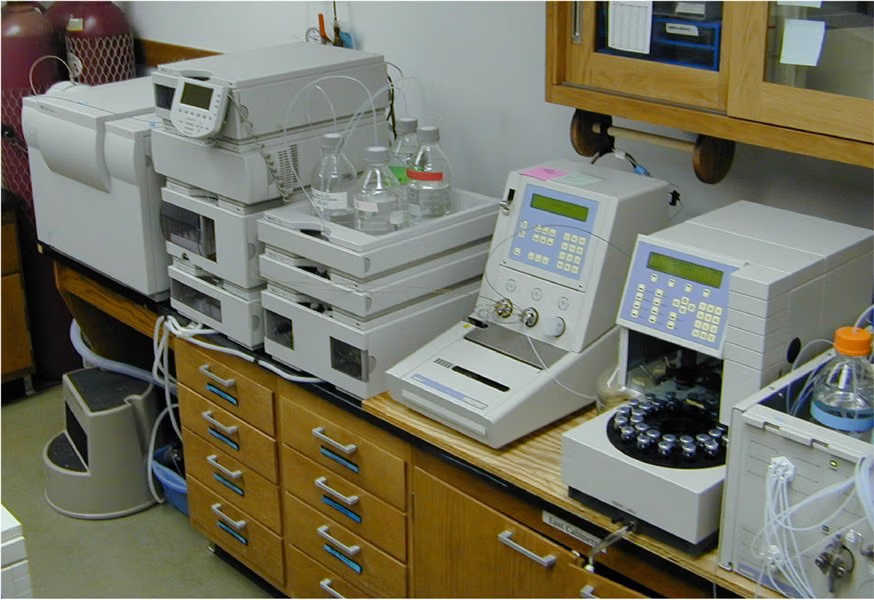
High performance liquid chromatography is based on passing the sample through a packed column under pressure with a liquid mobile phase. Components move at different speeds according to their affinity for the stationary phase and leave the column at different times; they are measured with a UV, DAD, fluorescence or refractive index detector.
Purpose of HPLC Analysis
The purpose is to separate thermally labile or non-volatile compounds without degrading them and to determine their quantity. Active ingredient assay and impurity profiling in pharmaceuticals, and additive and vitamin determination in food, are done with this technique.
Which Products Is HPLC Analysis Applied To?
- Pharmaceutical active ingredients and finished products
- Food additives, preservatives and sweeteners
- Vitamin preparations and supplements
- Preservatives and UV filters in cosmetic products
- Polymer additives and antioxidants
In Which Sectors Is HPLC Analysis Used?
Standards Related to HPLC Analysis
- European Pharmacopoeia (Ph. Eur.) general chapter 2.2.29 — liquid chromatography
- USP <621> (chromatography)
- ICH Q2(R2) (validation of analytical procedures)
- EN 12856 / EN 12857 (determination of sweeteners and additives in food)
HPLC Analysis Conditions
- Kolon
- Fill and size defined in the method standard
- Hareketli faz
- Buffer/organic solvent ratio defined in the method; isocratic or gradient
- Detector wavelength
- It is specified in the method according to the absorption maximum of the analyte
- System suitability
- Solubility, tailing and reproducibility criteria defined in the pharmacopoeia
Equipment for HPLC Analysis
- High-pressure pump and gradient unit
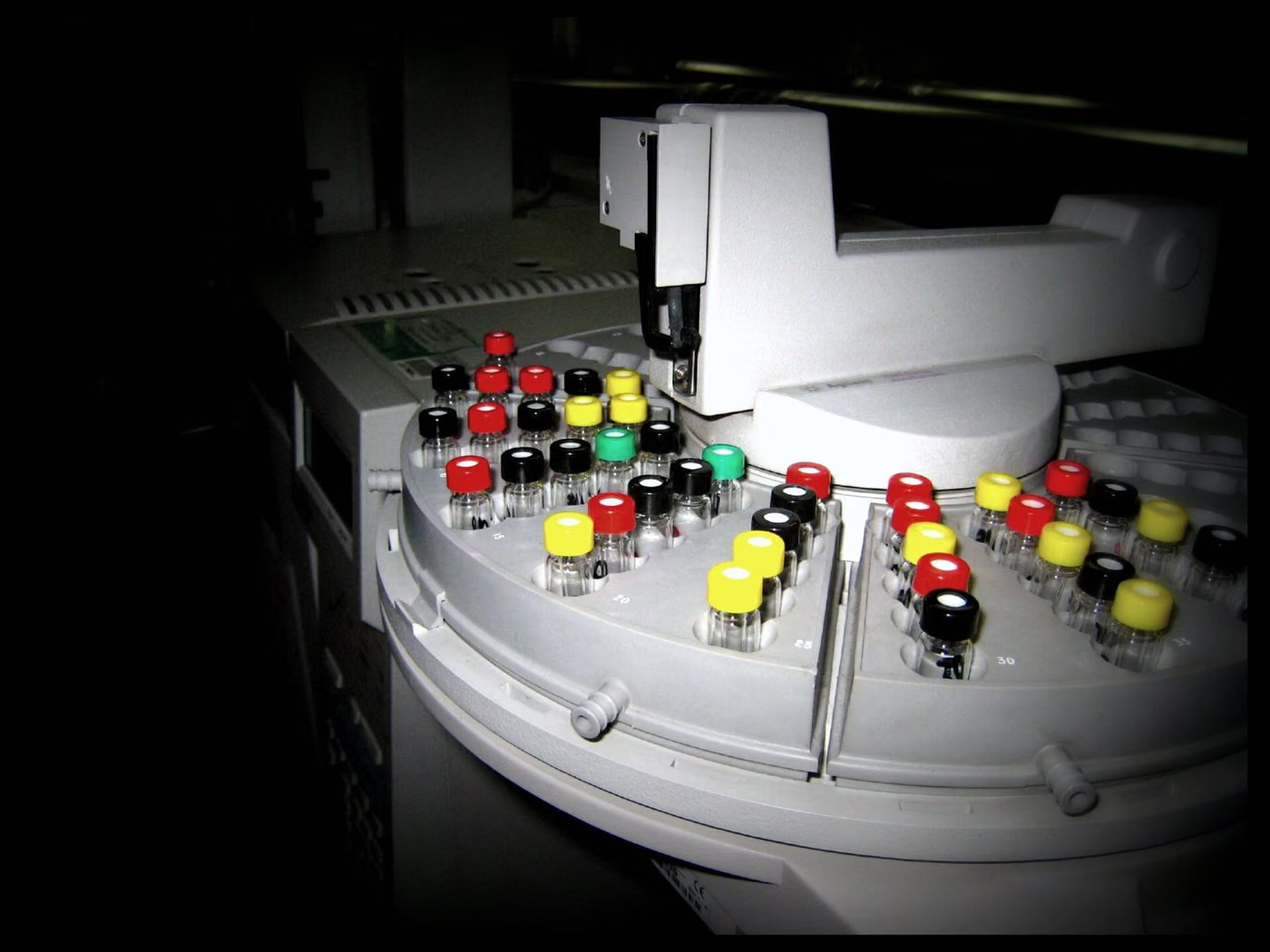
- Autosampler
- Column oven and analytical columns
- UV / DAD / fluorescence / RI detector
- Chromatography data system
Sample Requirements for HPLC Analysis
- The sample must be made soluble in the mobile phase
- Filtration (generally 0.45 µm or below) is required to prevent column clogging
- Grinding and extraction are applied for solid dosage forms
- Sample quantity varies by formulation; a few grams is generally sufficient
- Active ingredient and excipient information must be shared
Duration of HPLC Analysis
A single run is generally between 10–60 minutes. With system suitability tests, calibration and repeat injections, routine reporting takes a few working days.
HPLC Analysis Procedure
- 1The sample is dissolved, diluted and filtered.
- 2Calibration standards are prepared.
- 3A system suitability test is performed, and analysis does not proceed until criteria are met.
- 4The sample is injected onto the column and the chromatogram is recorded.
- 5Peaks are identified by retention time.
- 6Peak areas are evaluated according to the calibration curve.
- 7The result is verified with quality control samples.
HPLC Analysis Acceptance Criteria
Active ingredient content and impurity limits come from the pharmacopoeia or the registration dossier; in food and cosmetics the relevant additive regulation applies. The method itself does not define a limit.
Evaluation of Results
Results are calculated from the calibration curve. In a laboratory where the method has been validated, linearity, recovery, repeatability and the limit of quantification are established beforehand; the value in the report is meaningful within this validated range.
HPLC Analysis Report
- Sample description, receipt date and laboratory number
- Method applied and reference standard, if any
- Instrument and measurement conditions
- Sample preparation steps
- Measurement results and units
- Measurement uncertainty (if requested)
- A statement that the results relate only to the sample submitted for testing
Accreditation
EUROLAB holds internationally recognised accreditation obtained from accreditation bodies party to the IAF and ILAC multilateral recognition arrangements, under ISO/IEC 17025 for laboratory testing, ISO/IEC 17020 for inspection and surveillance, and ISO/IEC 17021-1 and ISO/IEC 17065 for system and product certification. This chain ensures the reports and certificates issued are accepted worldwide.
Whether this test can be offered within accredited scope depends on your product and the standard applied; since accreditation is method-based, the scope is confirmed in writing at the quotation stage.
Scope and authorisationsRelated Regulations
- European Pharmacopoeia and USP monographs
- EU 1333/2008 (food additives)
- EU 1223/2009 Cosmetics Regulation
- ICH Q3A / Q3B (impurities)
Pages Where This Method Is Used
Analytical Methods — What Does This Group of Methods Do?
The section below describes the field that the HPLC Analysis test belongs to; the conditions and acceptance criteria of this particular test are given in the sections above. The scope specific to your product is confirmed in writing at the quotation stage.
Analytical method pages are pages about a MEASUREMENT TECHNIQUE rather than about a test. The difference matters: "salt spray testing" is a test and answers one question; "ICP-MS" is a technique and is used in dozens of different tests. Sometimes the user is looking not for the test but for the technique — because the method name is what appears in their specification.
This distinction becomes decisive in choosing a laboratory. When a customer asks for "heavy metal analysis", the real question is by which technique it will be done: XRF is fast and non-destructive but does not distinguish compounds; AAS is economical for a single element; ICP-OES screens multiple elements; ICP-MS sees trace levels. The same sample gives results with different detection limits and different uncertainties across the four techniques.
Method selection is made against three criteria. DETECTION LIMIT: is the concentration sought within the range the method can see? MATRIX COMPATIBILITY: is the sample matrix (plastic, food, soil, metal) one the method can handle, and is pre-treatment required? SPECIFICATION LINK: does the product standard or legislation mandate a particular method? The third often overrides the first two — the specification binds the method.
Method pages build a CHAIN. A technique is linked to the test pages where it is used, to the standards those tests rest on, to the legislation those standards are tied to and ultimately to market access regimes. The example chain in the source document works like this: XRF → metal analysis → RoHS compliance → heavy metal restriction → coating pages. Whichever link the user enters from, they reach the others.
Sample preparation is the invisible half of the result in this family and is a greater source of error than the technique itself. The digestion method, degree of grinding, extraction solvent and dilution ratio change the result markedly. The same sample on the same instrument gives a different result with different preparation; the definition of the method therefore covers preparation too.
Calibration and verification are the third determining component. An instrument is calibrated with certified reference material, the calibration curve is verified periodically and a control sample is run in each batch. Without these steps, a number produced is not traceable even if the instrument is working correctly.
Method groups in this field
Elemental analysis
ICP-OES, ICP-MS, AAS and XRF. They differ in detection limit, matrix tolerance and multi-element capacity.
Chromatography
GC, GC-MS, HPLC, LC-MS/MS and ion chromatography. It separates a mixture into its components and measures each separately.
Spectroscopy
FTIR, Raman, UV-Vis and optical emission. For material identity, functional group identification and alloy composition.
Thermal analysis
DSC, TGA, DMA and dilatometry. Transition temperatures, composition, decomposition and dimensional behaviour.
Microscopy and imaging
Optical microscopy, SEM-EDS, radiography and tomography. Structure, defects and elemental distribution.
Classical (wet) chemistry
Titration, gravimetry and colorimetry. Used as a reference method and in confirming instrumental results.
Commonly confused in this field
- XRF is a screening tool; it sees elements and does not distinguish compounds. A decision on a restricted compound requires confirmation by wet chemistry.
- The phrase "not detected" is not proof of absence; it is read together with the detection limit of the method.
- The specification binds the method. A technically better method is not accepted if the specification calls for another.
- Sample preparation is part of the result; a report that does not state the preparation is not reproducible.
- Results obtained by different techniques cannot be compared directly; their detection limits and uncertainties differ.
- A method page is not a test page; which method applies to which test comes from the product standard.
Which decisions these results support
- Matching the method written in the specification to the laboratory's scope
- Method selection according to detection limit and matrix compatibility
- Confirming an instrumental result with a reference method
- Eliminating deviations arising from sample preparation
Related Tests

Frequently Asked Questions About HPLC Analysis
What is the difference between HPLC and UPLC?
The basic principle is the same. UPLC operates with smaller-particle packing and higher pressure; separation is completed faster with sharper peaks. Transfer is possible if the pharmacopoeial method permits a column change.
Why is a system suitability test mandatory?
It shows that the chromatographic system, on that day with that column, can achieve the expected separation. A result obtained without meeting the criteria is not accepted as valid.