

What Is Chemical Resistance?
Chemical resistance test is a test in which the sample is immersed in a defined chemical liquid at a defined temperature and time; It is an experiment in which the change in mass, size, appearance and mechanical properties is measured.
Purpose of Chemical Resistance
The aim is to verify that the material retains its properties against chemicals in the service environment.
Which Products Is Chemical Resistance Applied To?
- Chemical plant pipe and tank materials
- Automotive engine compartment parts
- Gaskets and sealing elements
- Coatings and primers
In Which Sectors Is Chemical Resistance Used?
Standards Related to Chemical Resistance
- ISO 175
- ASTM D543
- ISO 4599 (under tension)
- ISO 22088 (environmental stress cracking)
Chemical Resistance Conditions
- Kimyasal
- Liquid representing the service medium; defined in specification
- Temperature
- Service temperature or accelerated temperature defined in the standard
- Time
- Defined in the standard; typically days to weeks
- measured change
- Mass, size, hardness, appearance and tensile properties
Equipment for Chemical Resistance
- Dip pots and temperature-controlled baths
- Analytical balances and measuring instruments
- Tensile tester (post-exposure)
- Fume hood and chemical storage
Sample Requirements for Chemical Resistance
- Sample dimensions and surface condition must comply with the standard
- All measurements should be recorded before exposure
- Control samples (unexposed) should be kept together
- Chemical freshness and concentration should be monitored
Duration of Chemical Resistance
1–6 weeks depending on duration.
Chemical Resistance Procedure
- 1Samples are measured and weighed.
- 2The chemical is prepared and brought to temperature.
- 3Samples are immersed for a defined period of time.
- 4Samples are removed, cleaned and conditioned.
- 5Mass, size and appearance change are measured.
- 6Mechanical properties are measured again and compared to the control.
Chemical Resistance Acceptance Criteria
Acceptance criteria are given in the specification: mass/size change and loss of mechanical properties remain below the limit.
Evaluation of Results
Increasing the temperature may change the mechanism; The accelerated test result cannot be directly translated into service life. Circumferential stress cracking in material under tension develops much more rapidly than in stress-free immersion; If there is this risk, ISO 22088 type testing is required.
Chemical Resistance Report
- Standard applied
- Chemical, concentration and temperature
- Exposure duration
- Before/after measurements and control comparison
- Appearance findings
Accreditation
EUROLAB holds internationally recognised accreditation obtained from accreditation bodies party to the IAF and ILAC multilateral recognition arrangements, under ISO/IEC 17025 for laboratory testing, ISO/IEC 17020 for inspection and surveillance, and ISO/IEC 17021-1 and ISO/IEC 17065 for system and product certification. This chain ensures the reports and certificates issued are accepted worldwide.
Whether this test can be offered within accredited scope depends on your product and the standard applied; since accreditation is method-based, the scope is confirmed in writing at the quotation stage.
Scope and authorisationsRelated Regulations
- Product and facility specifications
Paint and Coating Testing — What Does This Testing Field Cover?
The section below describes the field that the Chemical Resistance test belongs to; the conditions and acceptance criteria of this particular test are given in the sections above. The scope specific to your product is confirmed in writing at the quotation stage.
Paint and coating testing measures the adhesion of a coating to the surface, its mechanical durability and its resistance to environmental effects. Because a coating is a thin layer, the results depend both on the material and on the QUALITY OF APPLICATION; the same paint gives an entirely different result over a different surface preparation.
This dual dependence is the most important knowledge in the field. A coating failure usually arises not from the paint itself but from the surface preparation: oil residue, insufficient roughening, an oxide layer or moisture. Coating tests therefore assess not only the product but also the process, and the results are used for process control.
COATING THICKNESS is a recurring variable in the field. Many durability results relate directly to thickness; a thin area becomes the starting point of corrosion. Thickness measurement is therefore reported routinely alongside the other tests and is usually taken at several points — thickness falls at edges and corners, especially on complex geometries.
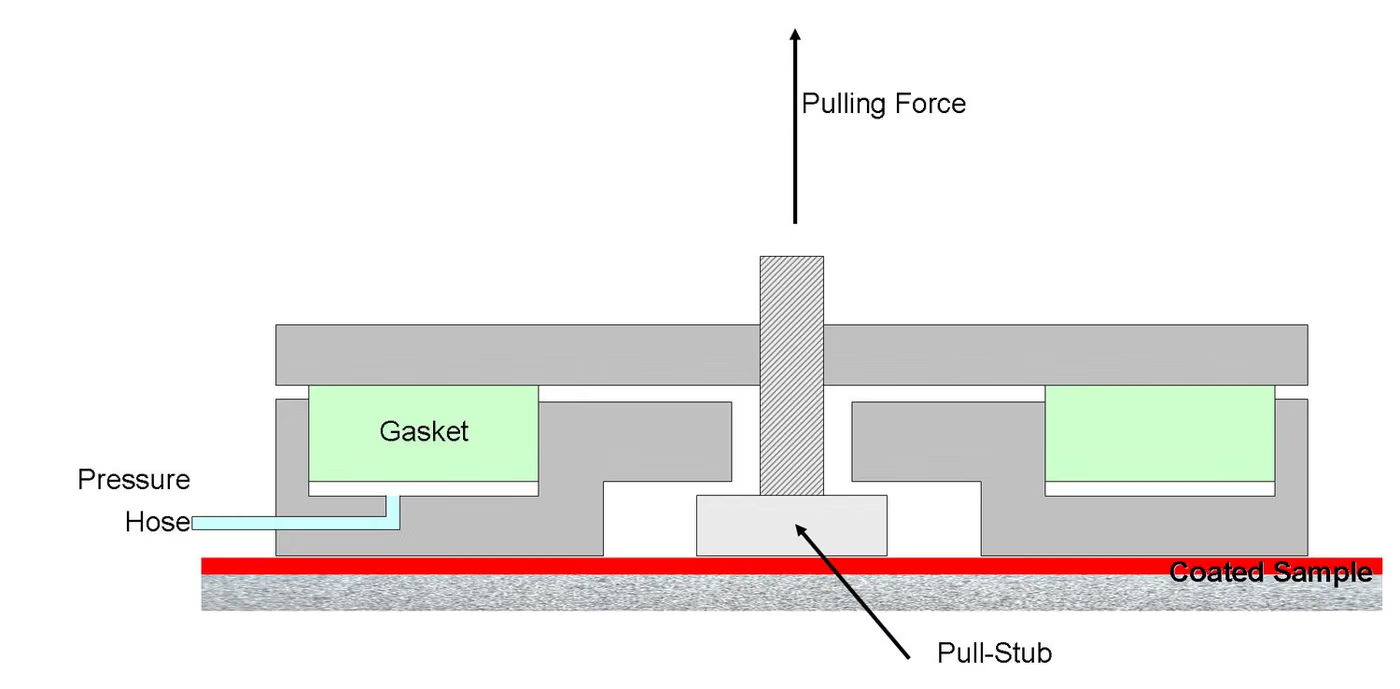
Three approaches are used on the adhesion side, each giving different information. The tape test is fast and suitable for field use but is a coarse scale. The cross-cut test shows behaviour at the intersections of layers. The pull-off method produces a numerical strength value and is the most suitable for comparison.
On the mechanical side, flexibility (mandrel bending), impact resistance, hardness, abrasion and stone chip resistance are measured. Stone chipping has a special place in automotive: gravel striking the coating under real road conditions is simulated, and the result is assessed according to whether the coating continues to protect the base metal.
On the appearance side, gloss and colour difference are monitored NUMERICALLY. Colour is assessed with a colour measuring instrument rather than by eye and the colour difference is expressed as a number; this makes it possible to compare different lots and different suppliers.
On the durability side, accelerated ageing (xenon arc, fluorescent UV), humidity, condensation and salt spray are applied. The result is assessed with scales for blistering, rusting, creep from a scribe and loss of adhesion; these scales are defined in separate standards and the report must state which was used.
In industrial processes such as powder coating and electrophoretic coating, the curing cycle (temperature and time) is what determines the result. An under-cured coating looks good but has poor chemical resistance and adhesion; oven profile measurement is therefore part of coating quality control.
Method groups in this field
Thickness
Dry film thickness by magnetic and non-magnetic methods; multi-point measurement and assessment of the distribution.
Adhesion
Tape test, cross-cut test and pull-off adhesion strength.
Mechanical strength
Mandrel bend flexibility, rapid deformation (impact), pencil and scratch hardness, Taber abrasion, stone chipping.
Appearance
Gloss measurement, colour difference calculation, orange peel and surface defect assessment.
Environmental durability
Salt spray, humidity, condensation, xenon arc and fluorescent UV ageing, chemical and stain resistance.
Assessment scales
Scales for blistering, degree of rusting, creep from a scribe and loss of adhesion.
Commonly confused in this field
- A coating result depends on the surface preparation; even if the paint itself is good, a poor preparation gives a poor result.
- A durability result without a reported thickness cannot be compared.
- The tape test is a coarse scale; numerical comparison requires the pull-off method.
- Colour cannot be assessed by eye; numerical colour difference measurement is required.
- An ageing result without a stated assessment scale cannot be interpreted.
- If the curing cycle is incomplete the coating looks good but its durability is poor; the oven profile is part of quality control.
Which decisions these results support
- Paint system approval and supplier selection
- Process control of the paint line and lot acceptance
- Supporting outdoor and automotive durability claims
- Detecting defects arising from surface preparation
- Monitoring colour and gloss consistency lot by lot
Related Tests



Frequently Asked Questions About Chemical Resistance
According to which standard is Chemical Resistance made?
Chemical Resistance is executed in scope ISO 175, ASTM D543, ISO 4599 (under tension) and ISO 22088 (environmental stress cracking). The limit values and acceptance criteria to be applied are defined in the product standard; The version valid for your product is confirmed in writing at the offer stage.
Which products does Chemical Resistance apply to?
Mainly applied to Chemical plant pipe and tank materials, Automotive engine compartment parts, Gaskets and sealing elements and Coatings and primers. Whether your product is included in the scope is determined by examining its technical specifications and intended use.
Under what conditions is Chemical Resistance done?
The determining parameters are: Kimyasal — Liquid representing the service medium; defined in specification, Temperature — Service temperature or accelerated temperature defined in the standard and Time — Defined in the standard; typically days to weeks. The full terms are in the "Test Conditions" section on the page and vary depending on the product standard.
What kind of sample is needed for Chemical Resistance?
Sample dimensions and surface condition must comply with the standard, All measurements should be recorded before exposure and Control samples (unexposed) should be kept together. The number of samples is determined according to the product standard and the scope to be reported.
How long does Chemical Resistance take?
1–6 weeks depending on duration. This duration belongs to the experiment itself; sample preparation, queuing and reporting are also evaluated. A realistic schedule for your product is given in the offer.
What is the Chemical Resistance result called "appropriate"?
Acceptance criteria are given in the specification: mass/size change and loss of mechanical properties remain below the limit.